


Brave1 Demo Days: What is it and how to participate in 2026
Article content
- What is Brave1?
- Why are Brave1 Demo Days needed?
- How Demo Day works: format and examples
- Who can participate?
- Project selection criteria
- How to apply to participate
- Benefits of participating in Demo Days
- Tips for participants
- Successful cases
- Conclusion
The Ukrainian defense technology market is experiencing unprecedented growth. Since 2014, demand for developments in the fields of drones, robotics, electronic warfare, software solutions for data analysis, and cybersecurity has pushed hundreds of engineering teams to look for new formats of interaction with the army and business. One of the most notable of these formats has been Brave1 Demo Days — public demonstrations where startups show a prototype or finished product, and investors, the military, and representatives of large defense companies immediately test, ask questions, and decide whether to move forward.
In the coming months, developers will have the chance to not only present their solutions, but also get feedback from potential customers and access funding thanks to Brave1 Invest Demo Days. In this article, we will take a closer look at how Demo Days work, who can apply, what projects Brave1 is looking for, and why participating can be a springboard for your startup.
What is Brave1?
Brave1 is an interdepartmental platform created by the Ministry of Digital Transformation of Ukraine together with the Ministry of Defense, the General Staff, and other government and commercial partners. Its task is to consolidate the efforts of developers, the state, and investors to accelerate the emergence of innovative solutions on the front line.
The platform offers:
- grant programs;
- access to training grounds and combat units for testing;
- consultations with lawyers on dual-purpose licensing;
- courses and mentoring programs;
- regular pitch days and, in fact, Demo Days.
It is the latter format that has become the most media-friendly, as it combines a short presentation, a live demonstration, and a direct dialogue with the end user.
What are Demo Days at Brave1?
Demo Day is a concentrated event lasting one working day, during which selected teams present the product to a wide audience. Presentations are usually held live; sometimes an online stream is provided for those who cannot be offline. The main idea is to show not a slide, but a working technology that can be “touched”: launch the copter, turn on the software, show how the robot goes around obstacles.
The format is not limited to a few minutes of stage performance. After the pitches, participants move to the expo area, where each visitor can ask questions and see how the solution works in real time. At the same time, the organizers schedule separate one-on-one meetings with potential investors or law enforcement representatives to discuss possible financing or a contract.
Why are Brave1 Demo Days needed?
For government customers, it is a way to quickly “scan” dozens of developments without lengthy bureaucracy; for investors, it is an opportunity to evaluate the team, technology, and market in a matter of minutes; for a startup, it is a chance to get specific feedback, media attention, and access to potential customers. Each Demo Day speeds up the “idea-contract” cycle by at least half compared to traditional tender procedures, and therefore increases the likelihood that a new solution will reach the forefront faster.
How Demo Day works: format and examples
The classic event lasts 5-6 hours and is divided into three blocks: pitches, expo tour, and private consultations. The organizers emphasize that the program may vary depending on the location and number of projects.
Typical event program
After registration and a short introduction by the moderator, a series of pitches begins. Each team has an average of 3-4 minutes for a presentation, followed by a few more minutes for questions from the jury. The jury traditionally includes officers from specialized units, representatives of ministries, venture capitalists, as well as experts in technical and business evaluation.
After the pitch block, participants and guests move to the demo zone, where developers set up stands. Here you can test the capabilities of the drone camera, evaluate the weight and ergonomics of the ground control station, or run the model in a simulation. At the end of the day, the organizers announce the winners of individual nominations (for example, “Best Software Product” or “Greatest Scalability Potential”), but for most teams, the key value is the contacts and agreements that arise behind the scenes.
Presentation examples
To better understand what an ideal demonstration looks like, organizers advise sticking to a simple structure of “problem – solution – benefits – call to action.” A typical scene might look like this:
- The engineer briefly outlines the combat mission (say, detecting enemy FPV drones within a radius of 3 km).
- Demonstrates a device or software, turns on live mode, and the audience sees the system sound an alarm during a test attack.
- Next are a few slides with technical specifications and a production roadmap.
- The final block is a clear request: “We need X thousand dollars for certification” or “We are looking for a partner with production capacity of 500 units per month.”
This approach helps keep attention and immediately shows that the team understands not only the technology, but also the business component.
Who can participate?
Brave1 officially invites any teams that can demonstrate a working prototype or finished product that has the potential to enhance defense capabilities or is dual-use in nature. Among the applicants, there are often:
- university R&D groups;
- private companies that already produce equipment for the civilian market and want to adapt it to military needs;
- startups at the pre-seed/seed stage that require a TRL (Technology Readiness Level) assessment and the first round of investment.
Requirements for participants
First of all, the team must provide a basic package: a description of the technical solution, a video or photo of a working sample, a short business plan, information about the founders. If the product is related to critical technologies (communications, encryption, electronic warfare), the organizers may ask to confirm the origin of the components and the absence of export control restrictions.
In addition, it is necessary to demonstrate at least minimal validation from end users: questionnaires, departmental feedback, or field test results. This is not yet a contract, but an important signal to the jury that the product was not created “in a vacuum.”
Types of projects accepted
Brave1 emphasizes that it focuses on six areas, but the list is not exhaustive:
- Unmanned aircraft systems.
- Ground robotics (sappers, logistics, medevac).
- C4ISR solutions: communications, control, intelligence, surveillance.
- Radio-electronic warfare.
- Cybersecurity and data protection.
- Medical tech for the front and evacuation.
Dual-use products that can be quickly scaled up in the civilian sector after the end of hostilities are particularly welcome.
Project selection criteria
The first stage is application screening. The platform team assesses compliance with the minimum requirements: the presence of a prototype, team expertise, and a basic economic model. Then, the questionnaires are sent to an expert council, which assigns scores based on five groups of indicators:
- innovativeness;
- readiness for production;
- scalability potential;
- practical benefit for defense;
- the realism of the business plan.
As a result, a shortlist of projects invited to Demo Day is formed. The number of places is limited, so the organizers advise not to leave the application until the last day.
How to apply to participate
To register, go to the developer account on the Brave1 website and click “Submit a project.” Next:
- Fill out the team profile.
- Add a description of the technology (one-pager or short deck), a photo/video of the prototype, and an indicative budget.
- Indicate whether you plan to apply for a grant or are looking for investment.
- Submit the form and wait for feedback.
Based on previous years’ experience, a preliminary response is received within 7-10 business days. If everything is in order, the team moves on to the stage of preparing a presentation with a Brave1 mentor. This is a rehearsal during which they help polish the pitch, prepare a demo, and calculate the unit-economy.
Benefits of participating in Demo Days
Even if your project doesn’t win a grant, you’ll gain publicity, contacts, and professional feedback. Below are the four main benefits that past participants mention most.
Direct access to investors
Demo Days are accredited by private agents, corporate venture funds and specialized accelerators. The post-pitch Q&A session often turns into a follow-up meeting on the same day. In fact, these are “speed dates” between money and technology: if there is chemistry, the parties do not need to look for each other in the market.
Opportunity to receive funding and media attention
Brave1 works with Ukrainian and international media, so immediately after the event, reviews are published that mention all speakers. For a startup, this is free PR and an additional trump card in negotiations. In addition, the most promising teams often receive invitations to internal pitch days in a closed circle of investors, where financing issues are resolved faster.
Networking with other developers
Sometimes the main revelation of Demo Day is not investors, but booth neighbors. Teams exchange supplier contacts, advise on field sites, and join forces to scale. For a small R&D team, a partnership with a manufacturer that already has an assembly line can be more valuable than the first check.
Feedback from experts
Officers and operators who see the equipment in combat every day are able to provide insight in one demo session that saves months of development. Conditionally: “Here we need to move the antenna 5 cm, and the signal will not be blocked by the armor.” Such feedback is invaluable, because it is not only about the quality of the product, but also about people’s lives.
Tips for participants
Here are some tips to help:
- Prepare the demonstration as a theater, not a lecture. When the audience sees a real drone flying or a robotic platform overcoming obstacles, the level of trust increases.
- Formulate the request directly: how much money or what resources are needed. Uncertainty demotivates the investor.
- Explain the economics: cost, potential market size, scaling plan. Even in the military segment, profitability matters.
- Take care of legality: licenses, export control, IP rights. Often, it is these “papers” that become an obstacle at the finish line.
- Practice on camera. Most Demo Days are broadcast online, and clear diction with visual cues helps get the point across.
Successful cases
Official Brave1 statistics show that after each Demo Day, several teams move to the next level of funding or sign agreements with government agencies. We have collected generalized examples that show the diversity of directions.
Within one Invest Demo Day, five teams presented their solutions:
- Drone software that creates a 360-degree camera view for the operator and augments it with artificial intelligence to find targets.
- A maritime unmanned carrier platform designed for reconnaissance or payload delivery.
- An autonomous loitering munition with a machine vision system capable of engaging targets at long distances with high accuracy.
- A navigation module for copters that allows the drone to identify a target and fly without GPS.
- An electronic warfare system that detects and blocks enemy FPV drones.
A common feature of all five teams was maturity: they already had experience in field testing and were looking for investments not for a prototype, but for scaling up production. According to open sources, several of these projects have entered the negotiation phase with private and institutional investors after Demo Day, and are also being tested in front-line units.
Conclusion
Brave1 Demo Days is not just another gadget exhibition, but a working tool that helps to quickly test a hypothesis, attract funding, and establish contact with the end user. For Ukrainian developers, defense technologies have long ceased to be a niche sector: today it is one of the most dynamic markets, where a startup can go from garage-prototype to contract within one year.
If your team is working on a project that could boost defenses or save lives, it’s time to get ready. Think through a demo, validate the solution with end users, gather key documents, and submit a proposal.
Brave1 is likely to announce several waves of registrations in 2026. Even though the competition is fierce, participating in the selection process is a valuable experience: you will gain expert insight, understanding of military standards, and possibly a strategic partner. The Demo Days audience is engineers, investors, the military, and the media—the very people who can turn your idea into a real battlefield solution.

Ready-to-fly aviation complex with remote control, tablet, mast-mounted repeater, FPV goggles, and 500 drones in the set
Warning: Undefined array key 1 in /home/hryf/drongrif.com/www/wp-content/themes/Proacto-Theme/template-parts/blocks/pr-products-sidebar.php on line 40
0
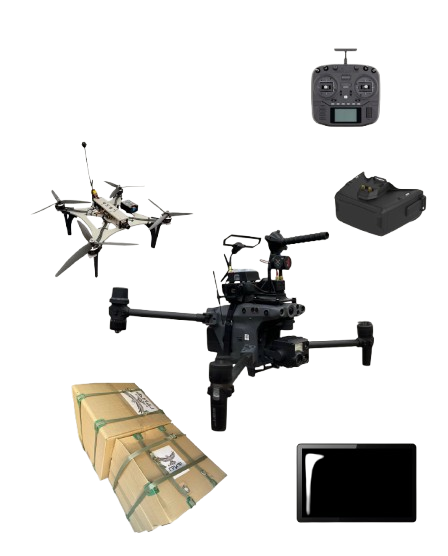
A complex with a Mavic charging station, a repeater and full support for combat missions.
Warning: Undefined array key 1 in /home/hryf/drongrif.com/www/wp-content/themes/Proacto-Theme/template-parts/blocks/pr-products-sidebar.php on line 40
0

FPV drone 10 for strike missions. Operating range up to 20+ km, combat load up to 3 kg. Ideal for mass use.
Warning: Undefined array key 1 in /home/hryf/drongrif.com/www/wp-content/themes/Proacto-Theme/template-parts/blocks/pr-products-sidebar.php on line 40
0

Powerful drone with anti-radar capabilities. ERLS system at frequencies of 520-2700 MHz. Combat load 2.5 kg, operational flight range — 25 km.
Warning: Undefined array key 1 in /home/hryf/drongrif.com/www/wp-content/themes/Proacto-Theme/template-parts/blocks/pr-products-sidebar.php on line 40
0
Frequently asked questions
-
Who organizes Brave1 Demo Days?
Coordination is handled by the Brave1 platform team with support from the Ministry of Digital Affairs, the Ministry of Defense, and partner donor programs. Logistics and media support are often outsourced to external agencies, but strategic decisions regarding selection and security are solely the responsibility of Brave1 and relevant government agencies.
-
What is the main goal of Brave1 Demo Days?
Bringing together defense technology developers with those who can provide resources and rapid implementation: from high-ranking customers to private investors. In fact, this is an accelerated showcase of innovations, where the state and business see what will be available tomorrow.
-
Can foreign investors participate in the event?
Yes, registration is open to foreign foundations and corporations. The organizers provide simultaneous translation and help with preliminary verification of documents to simplify legal nuances for transnational players. What are Brave1 Demo Days?
-
How much time is given for a project presentation?
The standard regulation is up to five minutes: three minutes pitch + up to two minutes for questions. If more time is needed for the demonstration, the team agrees in advance and can get additional minutes, but only if there are good reasons.