

What drones do the military need in Ukraine today?
Article content
- Why Ukrainian drones have become critically important for the Armed Forces of Ukraine
- Main types of drones for the military
- Military drones: characteristics to look out for
- How to choose the best drone for the military
- What drones does the Ukrainian Armed Forces need right now?
- TOP of the best drones for the Armed Forces of Ukraine with characteristics and advantages
Ukraine’s military drones have gone from volunteer experiments to full-fledged weapons, without which it is difficult to imagine modern combat. They replace artillery where it is absent, provide eyes where a person cannot go. They have saved hundreds, if not thousands, of Ukrainian military lives, and allow us to reduce the consequences of a superior enemy army.
Currently, there are many types of UAVs for different tasks and needs. Let’s analyze the main differences.
Why Ukrainian drones have become critically important for the Armed Forces of Ukraine
At the beginning of a full-scale war, drones were used mainly for reconnaissance. But within a few months it became clear that this was a separate type of weapon. Drones allow you to destroy valuable enemy equipment with devices costing several thousand dollars. Their use also allows you to save the lives of personnel, and in addition, they can operate in conditions where it is risky to send our aviation.
Drones are currently being used by the Ukrainian Armed Forces in various situations. They help to find exactly where the enemy is, tell artillery where it is best to fire, sometimes deliver small loads or work on equipment. In many areas of the front without drones, units would indeed find it much more difficult: sometimes it is simply impossible to get close to enemy positions.
Military drones are very different from civilian models. Their priority is not a good picture, but reliability, stable communication and the ability to work in conditions of active interference. They also have to pull the right load. These things determine whether the drone can do its job properly.
Military drones – features:
- Long flight and communication range
- Complex payload (cameras, ammunition, warhead, etc.)
- Increased resistance to countermeasures (EW, jamming, interceptors)
- Higher endurance to difficult conditions (bad weather, long routes, combat conditions)
- Variability of tasks and configurations (reconnaissance, adjustment, communications, strikes, cargo operations, sea / land / air)
Main types of drones for the military
Military drones are divided into several categories, and each of them fulfills its own role.
FPV drones for strikes and reconnaissance
FPV (First Person View) – small, fast, capable of accelerating over 100 km/h and flying into the windows or hatches of tanks. Can operate in urban areas, in landings and reach targets inaccessible to other weapons. In 2025, FPV will be the basis of strike unmanned aircraft on the front.
FPVs can carry explosive charges, from cut-off RPG grenades to high-explosive fragmentation charges. Such drones for the Ukrainian Armed Forces allow them to destroy equipment worth millions even with limited resources.
Quadcopters for tactical reconnaissance
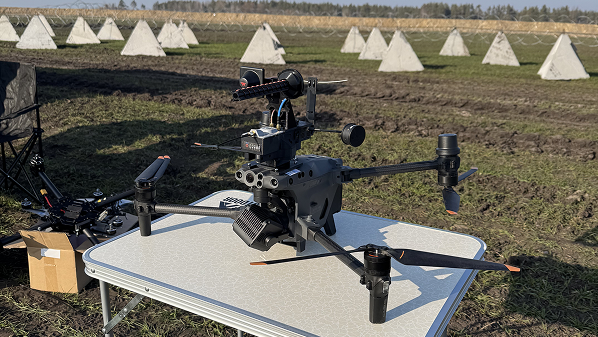
A quadcopter can patrol an area for hours, recording enemy movements, identifying artillery or armored vehicle positions, allowing commanders to make decisions based on current data.
Such military drones are usually equipped with stabilization systems, which allows you to get a clear picture even in windy conditions. They can operate at altitudes from a few meters to several hundred.
Quadcopters are also used to drop small munitions – grenades, mines, explosives. It’s not as spectacular as FPV strikes, but often the drone can return to base and fly out into the area again.
Long-range UAVs of the Armed Forces of Ukraine for surveillance and correction
Such drones are larger in size and can carry communication systems, signal repeaters, and electronic warfare equipment. The flight range of some models reaches 40-70 kilometers, which allows them to hit logistics hubs and warehouses far behind the front line.
Strategic and strike military drones
Such UAV models are designed to strike important targets in the rear: ammunition depots, infrastructure facilities, command posts. They are capable of flying long distances, sometimes hundreds of kilometers. They are launched for specific tasks, and not for daily work near the front line.
Military drones: characteristics to look out for
When fighters choose a drone for a specific mission, the parameters that determine the combat capability of the device are important.
Cameras and thermal imagers
If the operator cannot see the target, the drone is useless, so camera quality is one of the most important selection criteria. A thermal imager is also necessary for night operations.
Flight range and time in the air
Different tasks have different requirements. For tactical operations, a range of 10–20 km is usually enough. For work on distant targets, 40–70 km or more is needed. But no less important is how long the drone can stay in the air: some work for 15–20 minutes, others for hours.
Optics and zoom
Optical zoom allows you to see details at a great distance, identify the type of equipment, and count people. Digital zoom does not provide this opportunity. Reconnaissance drones have a 10-30x optical zoom. This allows you to observe the target from a safe distance without exposing the device to the risk of being shot down.
Resistance to electronic warfare
The enemy is constantly jamming signals, intercepting controls, and shooting down drones using electronic means. Therefore, resistance to electronic warfare determines whether a drone can complete its mission or not.
Possibility of suspending loads
FPVs usually carry 0.5-2 kg. Quadcopters – up to 5 kg. Heavy UAVs can lift tens of kilograms. The greater the load capacity, the more possibilities, but the dimensions and price increase.
Easy to manage and reliable
Reliability is when the device works in rain, snow, heat, does not fail from vibrations or fall in the middle of a mission, and has an interface that is intuitive for most operators.
How to choose the best drone for the military
There is no universal “best” drone. There are drones for specific tasks. Therefore, the choice always starts with the question: what needs to be done?
If the task is to quickly hit enemy equipment, they choose a high-speed FPV. If reconnaissance is needed, they take a quadcopter with a thermal imager and a long flight time.
In addition, there is the issue of price. Neither units, nor volunteers, nor the state can finance thousands of expensive drones, especially if they are disposable. But since their use can save the lives of soldiers, some Ukrainian companies are trying to create affordable and reliable drones that have a good balance of capabilities and cost. Such models are usually more affordable and are financed both by large funds and by the units themselves.
What drones does the Ukrainian Armed Forces need right now?
The needs of the front change, but there are basic categories that are always needed.
For reconnaissance
This requires quadcopters with high-quality optics, sometimes with thermal imaging cameras. They must transmit clear images over long distances, work in all weather conditions, and maintain a stable position in the air, even in strong winds.
For artillery adjustment
Such UAVs track a target that has already been identified, transmit coordinates, and help adjust fire in real time. They don’t have to have a long flight — the main thing is that the connection is stable and the camera allows you to accurately see changes in position after each shot.
For strike operations (FPV)
High-speed FPV with a payload of 1-2 kg, ideally with resistance to electronic warfare. They must be affordable so that they can be used on a mass scale. It is these drones that are today the main striking force on many fronts. It is they who often do not return to their position after completing the task.
For long-distance observation
Heavy UAVs with a range of 40+ km, capable of carrying powerful cameras and thermal imagers. They operate deep behind enemy lines, detecting equipment accumulations, logistical routes, and command posts. Such reconnaissance is critical for planning operations.
For night and special operations
Drones with high-quality thermal imagers, low noise, and minimal light signature. They allow you to operate at night, when traditional reconnaissance is powerless.
TOP of the best drones for the Armed Forces of Ukraine with characteristics and advantages
Ukrainian manufacturers have created several models that have already proven themselves on the front. /Let’s talk about our GRIF drones, which are designed and manufactured in Ukraine specifically for the needs of the Armed Forces of Ukraine.
FPV drone GRIF
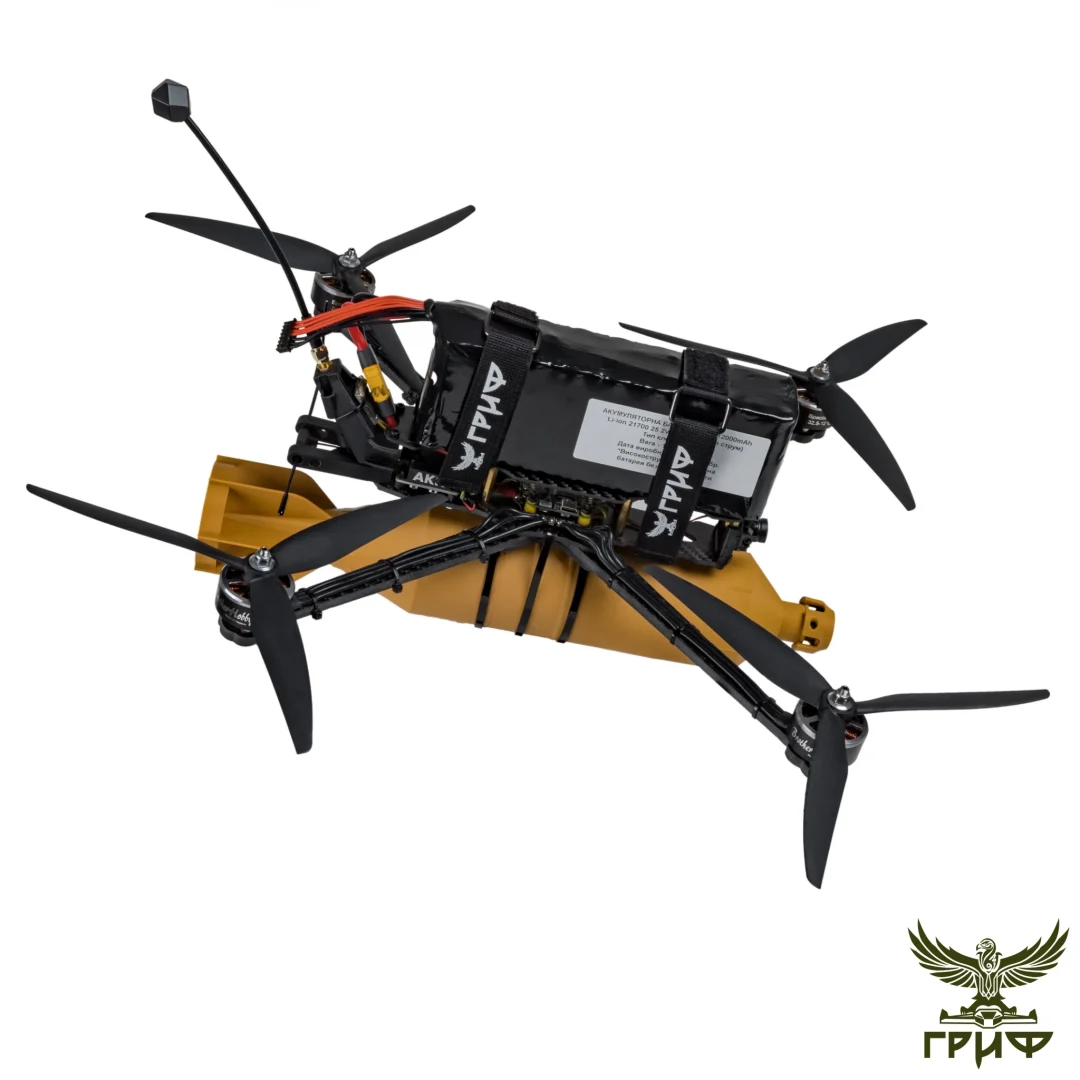
The GRIF FPV drone is a basic model for strike operations. 10-inch carbon body, speed up to 130 km/h, range over 20 km. Resistant to electronic warfare, capable of carrying a warhead of up to 1.5 kg.
Drone with thermal imaging camera GRIF-T
GRIF-T is a version with an integrated thermal imager. This model can work, detecting targets even in complete darkness. The thermal imager allows you to see the thermal traces of equipment that has just shut down its engine, detect camouflaged positions, and track the movement of people.
GRIF-Wholesale 15
GRIF-Opto 15 is a fiber-optic model, invulnerable to electronic warfare. Control is carried out via a thin cable that the military drone unwinds during flight (reels of 15 and 20 km). This completely eliminates the possibility of signal jamming or control interception.
Grif-Pro UAV
The Griffin-Pro UAV is an improved version of the basic model with a longer range and flight time. This model has better weather protection, a reinforced structure, and the ability to carry additional equipment. If the basic Griffin is a universal, then the Pro is a version for more complex tasks.
Drone 10 inches GRIF PPRC (Anti-EW)
GRIF PPRCH is a model with a software-reconfigured operating frequency. What this means is that the drone constantly changes the signal transmission frequency, which complicates the operation of electronic warfare systems. The enemy cannot tune in to a specific frequency and jam it, because the signal is constantly “jumping”.
GRIF 15 inches
The 15-inch GRIF is a heavier version capable of carrying a larger payload. It can carry a charge of up to 3 kg, which allows it to hit even heavily protected targets. The larger dimensions also provide greater stability in flight, better wind resistance, and the ability to install more powerful batteries. This model is suitable for strikes on fortified positions, armored vehicles, and buildings.

FPV drone 10 for strike missions. Operating range up to 20+ km, combat load up to 3 kg. Ideal for mass use.
Warning: Undefined array key 1 in /home/hryf/drongrif.com/www/wp-content/themes/Proacto-Theme/template-parts/blocks/pr-products-sidebar.php on line 40
0

FPV drone 10 for strike missions. Operating range up to 25 km, payload up to 3 kg. Ideal for mass use.
Warning: Undefined array key 1 in /home/hryf/drongrif.com/www/wp-content/themes/Proacto-Theme/template-parts/blocks/pr-products-sidebar.php on line 40
0

Powerful drone with anti-radar capabilities. ERLS system at frequencies of 520-2700 MHz. Combat load 2.5 kg, operational flight range — 25 km.
Warning: Undefined array key 1 in /home/hryf/drongrif.com/www/wp-content/themes/Proacto-Theme/template-parts/blocks/pr-products-sidebar.php on line 40
0

Powerful drone for heavier tasks, equipped with X 4215 motors, 8S3P battery and 80-100A flight controller. Combat load 5 kg, operational flight range — 20+ km
Warning: Undefined array key 1 in /home/hryf/drongrif.com/www/wp-content/themes/Proacto-Theme/template-parts/blocks/pr-products-sidebar.php on line 40
0

15″ FPV drone with 15 and 20 km coils. Load capacity 3+ kg. Reliable in electronic warfare zones.
Warning: Undefined array key 1 in /home/hryf/drongrif.com/www/wp-content/themes/Proacto-Theme/template-parts/blocks/pr-products-sidebar.php on line 40
0

A new generation FPV drone with a built-in mini-PC based on Raspberry Pi. Autopilot, cruise control, stable movement, precise hitting
Warning: Undefined array key 1 in /home/hryf/drongrif.com/www/wp-content/themes/Proacto-Theme/template-parts/blocks/pr-products-sidebar.php on line 40
0

FPV drone with thermal imaging camera for night operations and precision strikes. Up to 3 kg of ammunition, range – 25 km.
Warning: Undefined array key 1 in /home/hryf/drongrif.com/www/wp-content/themes/Proacto-Theme/template-parts/blocks/pr-products-sidebar.php on line 40
0
Frequently asked questions
-
Which drone is best for the Armed Forces of Ukraine?
There is no single “best” drone. It all depends on the task. For quick strikes – FPV type GRIF. For work in conditions EW – fiber optic models. The best A military drone is one that performs a specific task most effectively.
-
What FPV drones are currently in combat use?
All versions of the Griffin models are currently in use by units of the Armed Forces of Ukraine. are used. The Ukrainian army also uses both hand-assembled FPVs based on components from the civilian market, and industrial models designed specifically for combat missions.
-
What drones does the military need?
First of all, Ukraine’s military drones – are reliable and affordable. The military needs thousands of devices every month to compensate for the superior enemy army. These are FPVs for strikes, for reconnaissance, correction and other tasks. They must be resistant to electronic warfare, easy to operate, with the possibility of quick repair.